Human-made wildness
H is for HawkHuman-made wildness is the idea that wildness need not be the opposite of human presence: it can take shape through landscapes altered by work, disaster, and deliberate care, and through relationships in which an animal remains distinct from the person attending to it. The book develops this idea most directly through Brecklands and the return of British goshawks, then tests it in the close, changing encounters between Helen Macdonald and Mabel. In both settings, human influence helps make the conditions for wild life without fully determining what that life will do.
A landscape made by human history
Brecklands appears not as an untouched refuge but as a place layered with human use and ecological consequence. A pond in the dunes is a bomb crater left by a German bomber during the war. Elsewhere, the landscape bears traces of ancient flint working, while its sandy ground holds the effects of farming and grazing. The account’s attention to these features makes history part of the place’s ecology: the pond, the flint, and the sand are not incidental scenery but evidence of successive human interventions and presences.
The region’s shifting sands make that history especially stark. Rabbits were farmed there for meat and felt in large enclosed warrens, and their grazing, together with that of sheep, reduced vegetation to a thin covering over sand. In 1688, strong south-westerly winds lifted and displaced the exposed ground. The resulting disaster engulfed Santon Downham and choked its river; dunes later extended for miles across the area. This was neither a pristine landscape nor a simple account of nature acting alone. Human uses helped leave the ground vulnerable, and the weather transformed that vulnerability into lasting change.
Later, much of the dune landscape was hidden beneath pines planted in the 1920s to supply timber for future wars. The forest therefore carries another human purpose within it, even as it becomes habitat and a setting for wildlife. Helen Macdonald values this mixed history rather than treating it as a defect in nature. Brecklands feels wild to her not because people have left no trace, but because industry, forestry, commerce, disaster, and work have combined to make an unusual countryside. The landscape’s wildness is inseparable from its human history.
Goshawks and the work of return
The goshawk’s history provides a parallel to the landscape. Goshawks once bred across the British Isles, but land enclosure restricted ordinary people’s ability to fly hawks, while accurate firearms made shooting more fashionable than falconry. As attitudes changed, goshawks came to be treated as vermin; persecution by gamekeepers and habitat loss contributed to their decline. By the late nineteenth century, the British population was extinct. A photograph of one of the last birds, preserved as a stuffed specimen, marks the difference between a living population and a remnant held as an image.
In the 1960s and 1970s, falconers began a quiet, unofficial effort to return the species. The British Falconers’ Club recognized that the cost of importing a goshawk for falconry could also cover a second bird to be released. Falconers brought birds from Sweden, Germany, and Finland, and released them in forests around Britain. Some releases were intentional; other birds were lost. The goshawks survived, found one another, and bred. Their descendants eventually numbered around 450 pairs.
This recovery complicates any definition of the wild as what exists beyond human influence. People had contributed to the species’ disappearance through land use and persecution; later, some of the same human community helped establish conditions for its return. Yet the falconers did not thereby make the goshawks tame or fully controllable. The birds survived and bred beyond the purpose for which individual imports had been acquired. The recovery is human work, but its outcome exceeds the original human transaction.
Attention, training, and animal agency
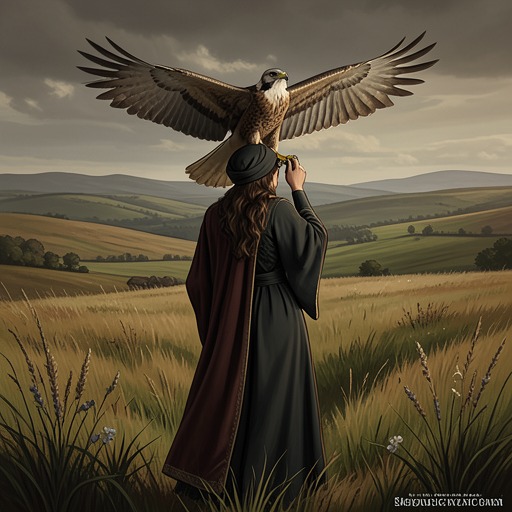
The book also explores human-made wildness at the scale of a single relationship. Training a goshawk requires close attention to posture, feather position, and small changes in expression. Helen Macdonald describes how this vigilance becomes a way of anticipating the bird’s responses. That practice changes the observer as well as the observed: rather than treating the hawk as a fixed emblem of wildness, the trainer learns to notice an individual animal’s changing states and to adjust her own conduct accordingly.
Mabel’s early experiences show that the resulting relationship is not simply a matter of human command. During a visit from Christina, Mabel is unhooded while Christina reads the newspaper. After a period of observation, the hawk tolerates the unfamiliar activity. Later, when Mabel makes a sudden bate, Macdonald first supposes that the bird is frightened, then recognizes frustration and hunger in her response. Mabel’s first meal from the fist takes place with another person in the room and a television playing, not in the solitude Macdonald had imagined. The episode unsettles the handler’s expectation of how trust should appear and when it should arrive.
Play offers a further challenge to received ideas. Mabel investigates and bites a strip of paper, follows it as it is offered again, and engages with a rolled magazine as Macdonald looks at her through it. Later, Macdonald makes toys from paper, tissue, and card; Mabel picks them up, drops them, and tosses scrunched paper back when it is thrown to her. These actions do not make Mabel a human companion in disguise. They show an animal responding creatively within a shared activity, while the human participant revises what she had assumed a goshawk could be. The relationship is made through repeated attention and interaction, not through the erasure of difference.
Social ideas projected onto wildness
The book places falconry within histories of access and status as well as species knowledge. A goshawk can hunt after a short flight from the fist, while flying falcons properly requires extensive open ground, such as grouse moors, partridge estates, and large areas of farmland. The distinction has social consequences: access to falconry with falcons was associated with wealth and connection, whereas goshawk training could be practised in more limited spaces. Historical writing reflects this hierarchy by praising the falcon as noble and perfect while describing the goshawk as disagreeable or inferior.
Descriptions of the female goshawk also expose how human judgments can pass as natural facts. Later falconry books repeatedly characterize goshawks as sulky, contrary, or difficult. Earlier writers, including Simon Latham and Edmund Bert, describe them as shy and fearful but also sociable and capable of affection when treated with consideration. Macdonald does not claim that these older accounts escape the assumptions of their time. Their importance is that they allow for the falconer’s conduct to matter: a hawk’s response need not be explained solely as an inborn defect in the animal.
The contrast makes the idea of human-made wildness ethical as well as ecological. Human beings do not merely encounter a ready-made category called the wild; their land management, hunting conventions, training practices, and descriptions of animals shape what they can encounter and how they interpret it. But the goshawk’s independent survival, Mabel’s unanticipated play, and the birds’ distinct responses prevent that influence from becoming a claim of ownership over wildness itself. The concept holds together human responsibility and animal agency: people can help create the conditions in which wildness persists, while the lives that emerge remain more than human designs.